GENCO for Corrective Grid Planning
Neural initialization, solver workloads and verified outcomes.
Bikash Sah · Chair of Interconnected Automation Systems · Bikash.Sah@uni-siegen.de
Final comparison:
Ten methods share a FIFO scheduler, seven CPU correction workers and one coordinator. GPU predictions provide optional seeds. Medians summarize ten balanced repetitions on each grid.
| Method | Service wait (s) | Economic wait (s) | Accepted / total | Economic / total | Neural seeds |
|---|
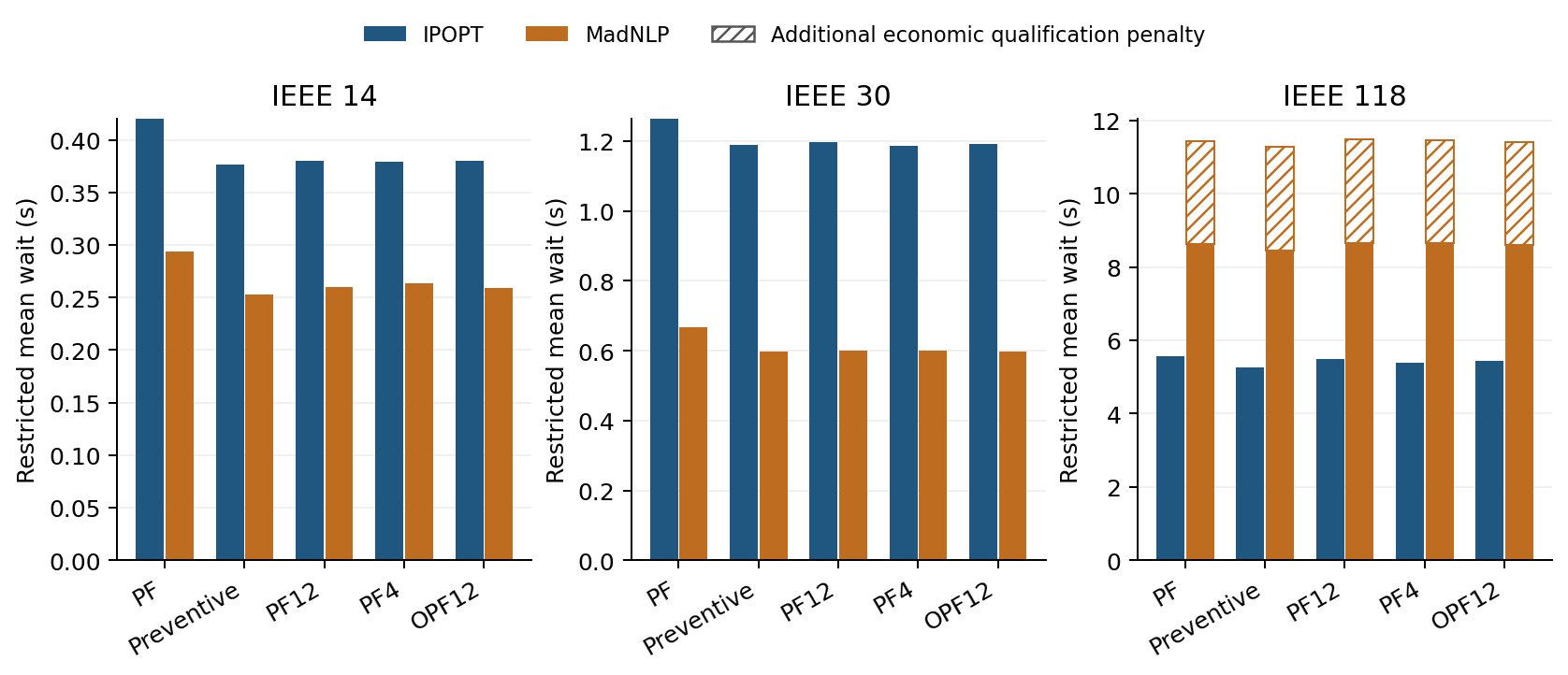
An unqualified case receives the complete deadline: 60, 120 or 300 seconds. The economic allowance is max(0.0001, 0.001 × |reference objective|). The reference is a local IPOPT comparison anchor. A passed audit means the records and numerical classifications agree.
Approach:
The project began with EV support under severe grid conditions. The measured experiment examines connected-grid AC corrective planning. Critical load, remaining load and operating cost are optimized in three lexicographic stages.

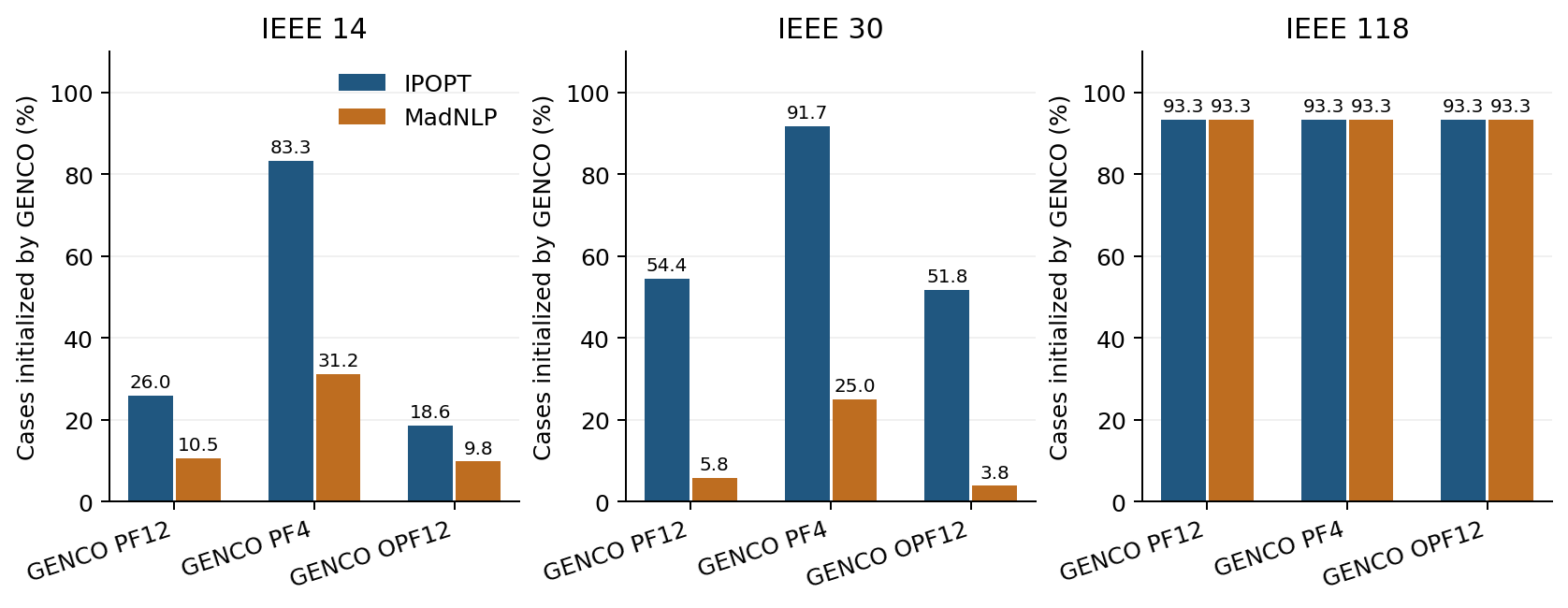
GENCO PF12, fixed four-layer PF4, and OPF12 use released fixed weights. Graphkit supplies the inference implementation; the pinned DataKit power-balance implementation supplies an additional check. PF4 is an approximate computation. Eager/replay qualification compares each variant with its own eager execution.
What the records show:
Quality and failures:
23,000 online plans were accepted and service matched; 22,950 also met the economic condition. Two IEEE 118 MadNLP scenarios reached the cost-stage iteration limit in both attempts, giving 100 unresolved evaluations. A third produced 50 additional economic failures.
Actual neural contribution:
Four-layer inference shortened producer elapsed time by about 1.75–1.90× in the IPOPT workloads. CPU workers sometimes dispatched small-grid events before prediction arrived. Inference time and time to a qualified plan therefore have separate measurements.
OMNI hardware and reproducibility:
The University of Siegen OMNI cluster provided AMD EPYC 7452 CPUs and Tesla V100-PCIE-16GB GPUs. Each grid task requested eight physical cores, 32 GB host memory and one GPU. CPU correction used IPOPT and MadNLP/ExaModels in Float64. GPU inference used PyTorch 2.7.1+cu118 with CUDA graph capture and fixed equivalence checks.
Full final inputs, source, attempts, logs, GPU identities, CPU affinity, checkpoint revisions and parameter hashes are retained. Julia 1.10.10 and the exact Julia manifest are included. Direct Python versions are observed records; a complete transitive Python wheel lock was not captured.
Recorded hardware and qualifications · Frozen configuration · Checkpoint manifest · Recheck script
Development and next experiments:
The historical ledger enumerates 2,094 retained workload campaigns. Inference probes, qualification cells and startup failures have separate records. The release contains complete final raw evidence and earlier summary extracts with archive hashes.
The next experiments examine MadNLP robustness on the three 118-bus outliers, task-specific corrective prediction, larger systems, and time-coupled EV energy and electrothermal constraints. Connected outages, synthetic priorities, known topology families, local references and unknown training overlap define the scope of the present result.
Development ledger · Editable LaTeX · Attribution and licenses